| 03-18-02
With state government up to its eyeballs in budget
misery and other fiscal concerns, I would suggest a way to kill "two
(proverbial) birds with one stone." I know that sounds silly, but
let me explain my idea.
As I am sure you know, our Department of Transportation
(DOT) is responsible for roadside maintenance of some 1,100 miles of roads,
including the interstates.
Via the grapevine, I have learned that the DOT,
in one way or another, last year spent roughly $6.8 million mowing so-called
weeds and grasses along these 1,100 miles of roads which, in reality, translate
into roughly 22,000 miles if you are talking about both sides, and even
more than that when medians are considered.
My pitch is this: Eliminating unnecessary
mowing would help achieve two goals. First, it would help curb spending,
a desirable thing in these tight fiscal times. Secondly, it would give
resident--not to mention out-of-state--motorists a chance to see what Indiana
really is.
As I drive through other states, I see a great
variety of plant and animal life along the roadsides. In Indiana, I am
sad to say, I see signs like:
"CAUTION Mowing Crews Ahead," and tractors with
cycle bars cutting down the natural beauty of the state.
Dating back to the Pennsylvania Turnpike and New
York Thruway, the advent of interstate roadways set the stage for the onslaught
of interstates coast-to-coast and border-to-border.
In a swift society like ours, this is not all
bad. Fast travel can, at worst, be called a necessary evil, even
though the interstate network has robbed us of millions of acres of valuable
farmland and wildlife habitat.
Actually, one could believe, this should be of
no great concern to Hoosiers because we have almost reached our quota of
interstates. Only the extension of I-69 from Indianapolis to Evansville
is on the drawing boards now.
Still, the point of this column lies in the fact
that if mowing of roadsides and medians were curtailed, or replaced with
voluntary--even DOT financed--development programs, we would get a better
picture of what Indiana really is, while giving the budget folks some relief.
In some states, I see happy folks harvesting such
wild crops as blackberries, wild black raspberries, wild strawberries and
many other forms of edible natural produce along the interstates. I also
see beautiful displays of wild and cultivated flowers which obviously have
been cultivated by someone, perhaps volunteers, at no expense to government..
A few years back I suggested (in a column) that
we encourage the growth of wild berries along the medians and roadsides
for three reasons. First, they would help eliminate roads closed by drifting
snow. Secondly, they would create a median buffer between lanes, and third,
they would offer harvest opportunity for some really great food.
One legislator thought the column worth reading
on the floor of the Indiana House of Representatives, and there was
some dialogue with the DOT people thereafter. But the mowing goes on, ad
infinitum. Eventually it turned out to be one of those "great idea, let's
forget it" deals.
I think, if I were to lose control of my car and
it was headed across a road median on a collision course with an 18-wheeler,
I would druther tangle with a blackberry patch Said blackberry patch
would less abruptly stop most vehicles.
To go back to yet another column--actually a series
in the 1950s--and to bring to light another supposed foible in developing
wildlife habitat along busy highways, let me point out that there
are those who do not think we should lure wild critters to the roadsides
because we could be sealing their doom.
That series of columns elicited a friendly rebuke
from the national office of one of the country's leading wildlife conservation
organizations (headquartered in Washington, D.C.). Still, biologists at
the grass roots level did not think it a bad plan.
There can be little room to doubt that if a mommy
rabbit produces 10 or12 young in a roadside habitat in a summer, some of
them will die on the road--but the majority of her broods will have a good
place to live.
Wildlife biologists point out that one of the
problems quail are facing, in their efforts to recover from the blizzard
years, is a lack of transit habitat.
There are a lot of places today where habitat
is good and quail numbers are on the upsurge. It is also generally understood
that some of the quail in areas supporting good numbers of birds might
seek less crowded living conditions. But they won't fly five miles to the
nearest good habitat. Roadside habitat could give quail and other birds
and animals much needed travel lanes.
Unmown roadsides and medians would also be a good
place to protect--or introduce--endangered native plants, even trees. For
example, in recent years I have noticed that broom sedge (sage to most
Hoosiers) is showing strong growth along some of the interstates although
it is being decimated by housing projects, commercial building and other
projects.
I cringe at the thought of the road mowers moving
in as spring turns to summer and the "tidy up" tendencies of government
agencies emerge from their winter dormancy.
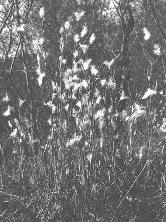
|
Small
patches of broom sedge (sage) along the interstates are making a strong
comeback of the plant as it is being crowded out by the developments of
large fields. This picture shows the plant in fall, the silky white
flowers remaining into winter. |
|
